

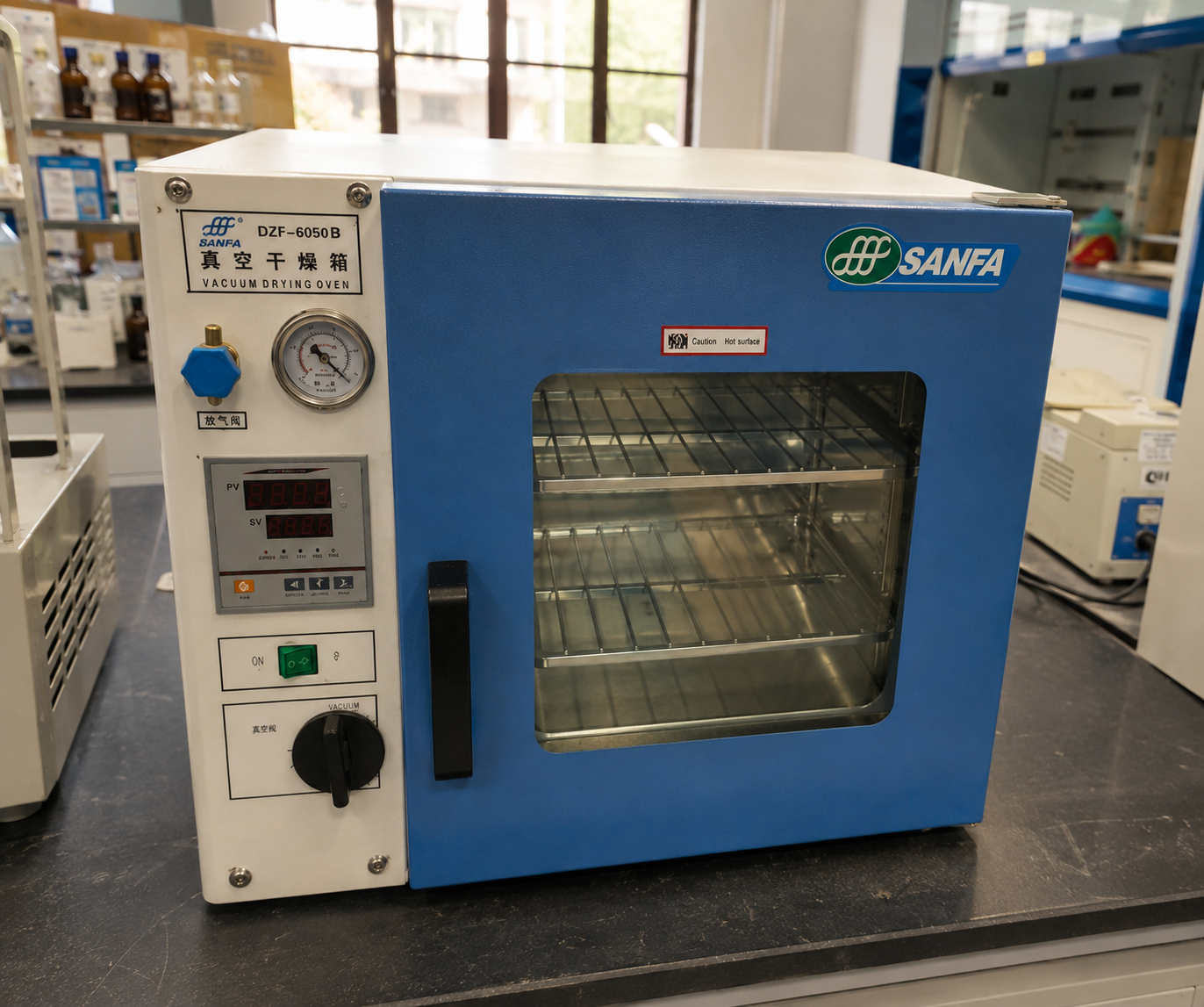
VACUUM DRYING OVEN
PRODUCT IDENTITY
───────────────────────────────
Product Name:
Vacuum Drying Oven
Brand:
SANFA
Model:
DZF-6050B
Equipment Category:
Laboratory Vacuum Drying Oven
Equipment Type:
Bench-top / cabinet-type vacuum drying oven
Primary Function:
Low-temperature vacuum drying, heating, preservation and moisture removal from laboratory samples under reduced pressure.
Country of Manufacture:
China
Manufacturer/Brand:
SANFA
Visual Identification:
The supplied instrument is clearly marked:
SANFA
DZF-6050B
VACUUM DRYING OVEN
PRINCIPLE OF OPERATION
───────────────────────────────
The DZF-6050B removes moisture from samples by combining
controlled heating with reduced chamber pressure.
Under vacuum, the boiling point of water and other volatile components is reduced. Consequently, moisture can be removed at a lower temperature than would normally be required under atmospheric conditions.
This makes vacuum drying particularly useful for heat-sensitive, oxidation-sensitive and easily decomposed materials. The chamber can also be operated with inert-gas filling where the configuration provides an inert-gas inlet.
TECHNICAL SPECIFICATIONS
───────────────────────────────
Model:
DZF-6050B
Temperature Range:
RT + 10 °C to approximately 65 °C
(approximately 10 °C above ambient to 65 °C)
Temperature Resolution:
0.1 °C
Temperature Fluctuation:
Approximately ±1 °C
Ultimate/Target Vacuum:
Approximately 133 Pa
Vacuum Indication:
Mechanical pointer vacuum gauge
Working Chamber:
Approximately 415 × 370 × 345 mm (W × D × H)
Approximate Effective Chamber Volume:
≈52 L
Chamber Material:
Stainless steel 304
Number of Shelves:
2
Electrical Supply:
AC 220 V, 50 Hz
Input Power:
Approximately 650 W
Recommended Ambient Operating Temperature:
Approximately +5 to +40 °C
Approximate External Dimensions:
Approximately 710 × 560 × 550 mm
Heating:
Shelf/contact heating configuration for this model family
Vacuum Pump:
Not necessarily supplied as standard.
An external vacuum pump is normally required unless the
specific supplied configuration includes one.
MAJOR CONSTRUCTION FEATURES
───────────────────────────────
• Stainless-steel internal chamber
• Double-layer tempered observation glass
• Silicone/rubber vacuum sealing gasket
• Mechanical vacuum gauge
• Digital temperature controller
• Adjustable door sealing mechanism
• Two removable shelves
• Vacuum connection port
• Heating system
• External vacuum-control arrangement
• Inert-gas inlet may be available depending on configuration
SUITABLE LABORATORY APPLICATIONS
───────────────────────────────
The DZF-6050B is particularly appropriate for:
• Drying plant materials
• Drying herbal materials
• Drying powdered samples
• Moisture removal from laboratory samples
• Drying heat-sensitive materials
• Drying oxidation-sensitive materials
• Sample preparation before extraction
• Preparation of samples for phytochemical analysis
• Preparation of samples for proximate analysis
• Drying biological materials where low temperature is required
• Drying pharmaceutical and natural-product samples
• Vacuum drying of extracts and other suitable laboratory materials
• Removal of residual moisture before grinding or storage
APPLICATION IN PHARMACOGNOSY / NATURAL PRODUCTS RESEARCH
───────────────────────────────
This equipment is particularly useful in pharmacognosy,
phytochemistry and natural-product laboratories.
Examples include:
Plant material
↓
Cleaning
↓
Cutting/slicing
↓
Vacuum drying
↓
Grinding
↓
Sieving
↓
Extraction / phytochemical analysis
Vacuum drying can help reduce exposure to atmospheric oxygen and allows moisture removal at relatively low temperatures.
It is therefore useful where excessive heat may cause degradation of thermolabile phytochemicals.
For plant samples, the selected drying temperature should be based on the research objective and the thermal stability of the target constituents.
IMPORTANT LIMITATION
───────────────────────────────
This model should NOT automatically be treated as a high-temperature vacuum oven.
The commonly documented DZF-6050B biological configuration has a temperature range of approximately RT + 10 °C to 65 °C.
Some manufacturers/catalogues use DZF-6050B for configurations specified up to 200 °C. Therefore, the actual temperature range of the SANFA instrument shown in the photograph should be confirmed from its original SANFA nameplate, manual or manufacturer documentation before operation above 65 °C.
VACUUM PERFORMANCE
───────────────────────────────
Reported ultimate vacuum:
≈133 Pa
Equivalent approximate pressure:
133 Pa = 0.133 kPa
Approximate pressure in mbar:
133 Pa ≈ 1.33 mbar
This is a substantial reduction from atmospheric pressure and is suitable for vacuum-assisted drying.
IMPORTANT:
The achievable vacuum depends on:
• Vacuum pump capacity
• Vacuum tubing
• Door-gasket condition
• Valve condition
• Chamber leakage
• Sample moisture load
• Ambient conditions
• Vacuum-pump oil/condition
SAMPLE PREPARATION USE
───────────────────────────────
For botanical samples, material should generally be:
• Clean
• Properly identified
• Free from excessive surface water
• Cut into reasonably uniform pieces
• Spread in a relatively thin layer
Avoid unnecessarily thick sample layers because they increase drying time and may produce non-uniform moisture removal.
For quantitative research, drying conditions should be recorded:
Sample mass before drying = W₁
Sample mass after drying = W₂
Moisture loss:
Moisture loss (g) = W₁ − W₂
Percentage mass loss:
% Mass loss =
[(W₁ − W₂) / W₁] × 100
IMPORTANT OPERATING CONSIDERATIONS
───────────────────────────────
• Do not exceed the verified temperature rating.
• Ensure the chamber door is properly sealed before applying vacuum.
• Use a vacuum pump appropriate for the required pressure.
• Inspect the vacuum hose and connections for leakage.
• Do not place corrosive chemicals directly inside the chamber
unless the chamber material is confirmed compatible.
• Avoid volatile or flammable materials unless the equipment and procedure are specifically rated for them.
• Do not abruptly release vacuum where sample disturbance could occur.
• Allow the chamber to return to a safe pressure before opening.
• Follow the manufacturer’s operating instructions.
QUALITY / RESEARCH RELEVANCE
───────────────────────────────
The DZF-6050B is especially valuable where conventional hot-air drying could cause:
• Excessive thermal degradation
• Oxidation
• Loss of volatile constituents
• Undesirable chemical reactions
• Changes in biological activity
Vacuum drying can provide a controlled low-temperature valternative.
For pharmacognostic studies, however, drying temperature and duration must be reported because drying conditions can affect phytochemical composition and antioxidant activity.
STORAGE / MAINTENANCE
───────────────────────────────
After use:
• Clean the chamber after cooling.
• Remove residual plant material and dust.
• Keep the chamber dry.
• Inspect the door gasket periodically.
• Check vacuum connections regularly.
• Inspect the vacuum gauge for abnormal readings.
• Maintain the vacuum pump according to its manufacturer.
• Keep the instrument protected from excessive humidity.
• Do not store corrosive residues inside the chamber.
SAFETY
───────────────────────────────
Primary hazards:
• Hot surfaces
• Vacuum/pressure differential
• Electrical supply
• Glass door breakage if damaged
• Chemical vapours from inappropriate samples
• Vacuum-pump exhaust contamination
Personal protective equipment should be selected according to the material being dried.
The oven should be installed on a stable laboratory bench with adequate ventilation and appropriate electrical protection.
RESEARCH APPLICATIONS
───────────────────────────────
Recommended research areas include:
• Pharmacognosy
• Phytochemistry
• Natural-product chemistry
• Pharmaceutical science
• Food science
• Agricultural science
• Microbiology sample preparation
• Biological sample preparation
• Herbal medicine research
• Proximate analysis
• Moisture determination
• Plant extraction studies
WLS QUALITY NOTE
───────────────────────────────
WLS INSIGHT:
The SANFA DZF-6050B shown is a genuine laboratory-type vacuum drying oven configuration based on the visible SANFA branding and DZF-6050B model designation.
The model is particularly attractive for laboratories working with botanical and pharmaceutical samples because vacuum drying allows moisture removal under reduced pressure and, in the low-temperature configuration, at temperatures substantially below conventional hot-air drying conditions.
IMPORTANT VERIFICATION:
Before listing or selling this particular unit as a “65 °C maximum” or “200 °C maximum” oven, WLS should verify the actual SANFA nameplate/manual supplied with the instrument.
The DZF-6050B designation appears in more than one documented configuration.
Recommended WLS listing specification:
“Temperature range: VERIFY FROM UNIT NAMEPLATE/MANUAL”
PRODUCT CLASSIFICATION
───────────────────────────────
Equipment:
Laboratory Vacuum Drying Oven
Application:
Low-temperature vacuum drying
Suitable sectors:
• Research laboratories
• Universities
• Pharmaceutical laboratories
• Pharmacognosy laboratories
• Phytochemistry laboratories
• Food laboratories
• Agricultural laboratories
• Natural-product laboratories
KEY SPECIFICATIONS AT A GLANCE
───────────────────────────────
Brand : SANFA
Model : DZF-6050B
Type : Vacuum Drying Oven
Capacity : Approximately 52 L
Temperature* : RT + 10 to 65 °C
Temperature Resolution : 0.1 °C
Temperature Stability* : ±1 °C
Vacuum : Approximately 133 Pa
Chamber : Stainless Steel 304
Internal Size : 415 × 370 × 345 mm
Shelves : 2
Power : Approximately 650 W
Supply : AC 220 V, 50 Hz
Vacuum Gauge : Mechanical
Application : Laboratory vacuum drying
*Verify against the actual SANFA unit before publication.
WLS PRODUCT DESCRIPTION
───────────────────────────────
SANFA DZF-6050B laboratory vacuum drying oven designed for controlled low-temperature drying of heat-sensitive, oxidation-sensitive and biological materials. It features a stainless-steel chamber, digital temperature control, mechanical vacuum indication and two shelves. The system is well suited to pharmacognosy, phytochemistry, pharmaceutical, food and natural-product research laboratories.




Reviews
There are no reviews yet.