

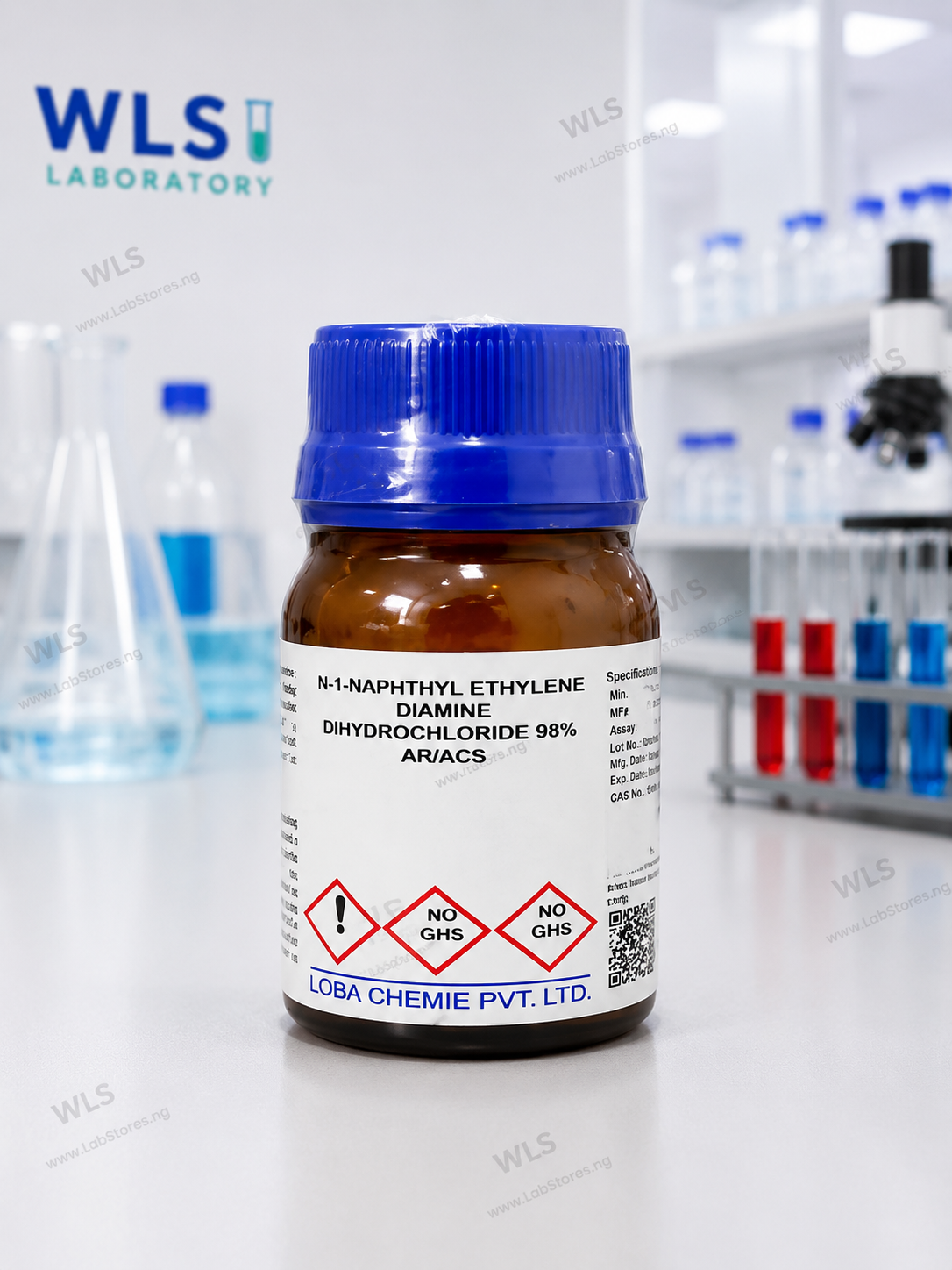
Product Name
N-(1-Naphthyl)ethylenediamine Dihydrochloride (NED)
Chemical Identity
- IUPAC Name: N-(Naphthalen-1-yl)ethane-1,2-diamine dihydrochloride
- Common Name: NED
- Molecular Formula: C₁₂H₁₄N₂·2HCl
- Molecular Weight: 259.18 g/mol
- CAS Number: 1465-25-4
- EC Number: 215-981-2
Grade & Compliance
- Grade: Analytical Reagent (AR) / Laboratory Reagent (LR)
- Purity: ≥ 98%
- Application Standard: Suitable for spectrophotometric analytical procedures
- Common Use Standard: Griess reaction and nitrite/nitric oxide determination
Physical & Chemical Properties
- Appearance: White to light pink crystalline powder
- Odour: Odourless
- Solubility: Soluble in water and dilute acidic media
- Stability: Light-sensitive compound
- pH Sensitivity: Performs optimally in acidic conditions
- Melting Point: ~215–220 °C (decomposes)
Specification (Typical Laboratory Limits)
- Assay: ≥ 98%
- Loss on Drying: ≤ 1.0%
- Sulphated Ash: ≤ 0.1%
- Heavy Metals: ≤ 0.001%
- Insoluble Matter: Passes test
Functional Uses (Laboratory Relevance)
- Chromogenic coupling reagent in Griess assay
- Nitric oxide (NO) quantification studies
- Nitrite determination in biological samples
- Environmental water nitrite analysis
- Biomedical oxidative stress research
- Spectrophotometric color development reagent
Analytical Principle
NED reacts with diazotized sulfanilamide under acidic conditions to form a stable pink azo dye measurable spectrophotometrically.
The chromophore intensity is proportional to nitrite concentration.
Typical absorbance measurement:
- 540 nm
- 543 nm
- 550 nm (method dependent)
Preparation Insight (Lab Use)
Typical preparation for Griess reagent:
- NED dissolved in distilled water or phosphoric acid medium
- Common concentration:
- 0.1% w/v NED solution
Usually paired with:
- Sulfanilamide
- Phosphoric Acid
Packaging & Presentation
- Container Type: Amber glass or HDPE reagent bottle
- Closure: Chemical-resistant screw cap
- Typical Pack Sizes:
- 1 g
- 5 g
- 25 g
- 100 g
Hazard & Safety Information
- GHS Classification: Irritant
- Potential Risks:
- Eye irritation
- Skin irritation
- Harmful if swallowed in large quantities
- Precautions:
- Avoid direct inhalation of dust
- Use gloves and laboratory eye protection
- Protect from direct light exposure
Storage Conditions
- Store in a cool, dry, dark environment
- Protect from light and moisture
- Keep container tightly sealed
- Recommended storage temperature:
- 15–25 °C
Shelf Life
- Typically 2–5 years under proper storage conditions
Manufacturer (Typical Suppliers)
- Loba Chemie Pvt. Ltd.
- HiMedia Laboratories
- Sigma-Aldrich
- SRL Chemicals
Quality Notes (WLS Insight)
- Highly important reagent in nitric oxide estimation protocols
- Sensitive to oxidation and light exposure; amber packaging preferred
- Produces highly stable pink azo chromophore with excellent spectrophotometric sensitivity
- Widely used in biomedical, environmental, and pharmaceutical analysis laboratories
Common Associated Reagents
- Sulfanilamide
- Phosphoric Acid
- Sodium Nitrite Standard
- Griess Reagent Components
Common Biomedical Applications
- Oxidative stress studies
- Inflammation research
- Nitric oxide metabolite quantification
- Antioxidant assay systems
- Cell culture nitric oxide studies
- Plasma and serum nitrite estimation



Reviews
There are no reviews yet.