


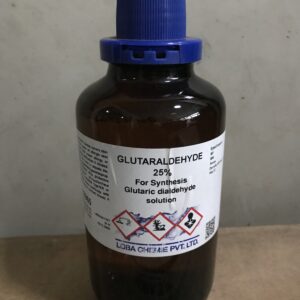
Glutaraldehyde Solution 25%
BRAND
Loba Chemie Pvt. Ltd.
PRODUCT CATEGORY
Laboratory Reagent / Chemical Intermediate / Disinfectant & Fixative Chemical
CHEMICAL NAME
Glutaraldehyde
SYNONYMS
Glutaric Dialdehyde
Pentane-1,5-dial
1,5-Pentanedial
CHEMICAL FORMULA
C5H8O2
MOLECULAR WEIGHT
100.12 g/mol
CAS NUMBER
111-30-8
GRADE
For Synthesis (Laboratory Grade)
APPEARANCE
Clear to pale yellow liquid with pungent odor
CONCENTRATION
25% Aqueous Solution
MANUFACTURER
Loba Chemie Pvt. Ltd., India
PRODUCT DESCRIPTION
Glutaraldehyde is a highly reactive dialdehyde widely used in laboratories, hospitals, biotechnology, histology, microbiology, and industrial applications. It functions as a powerful disinfectant, sterilizing agent, protein crosslinker, and tissue fixative. The 25% solution is commonly diluted before use depending on application requirements.
KEY APPLICATIONS
• Cold sterilization of medical and laboratory instruments
• Histology and electron microscopy tissue fixation
• Protein and enzyme crosslinking
• Biocide and disinfectant formulations
• Water treatment applications
• Polymer and resin synthesis
• Preparation of biological samples
• Immobilization of biomolecules
• Fixative in microscopy and pathology labs
LABORATORY RELEVANCE
Glutaraldehyde is extensively used in:
• Histopathology laboratories
• Biomedical research
• Microbiology laboratories
• Electron microscopy sample preparation
• Biochemistry and molecular biology labs
• Hospital sterilization units
TYPICAL WORKING CONCENTRATIONS
• Instrument sterilization: 2–4%
• Tissue fixation: 2–4%
• Electron microscopy fixation: ~2.5%
• Crosslinking reactions: Variable depending on protocol
PHYSICAL & CHEMICAL PROPERTIES
Physical State: Liquid
Color: Colorless to pale yellow
Odor: Sharp, pungent
Solubility: Completely miscible in water
Boiling Point: ~100°C (solution dependent)
pH: Usually acidic to neutral
Stability: Stable under recommended storage conditions
HAZARD INFORMATION
DANGER
Hazards Include:
• Toxic if inhaled or swallowed
• Causes severe skin burns and eye damage
• Strong respiratory irritant
• May cause allergic skin reactions
• Harmful to aquatic life
• Vapors may irritate mucous membranes
SAFETY PRECAUTIONS
• Use inside a fume hood or well-ventilated area
• Wear nitrile gloves, goggles, and lab coat
• Avoid inhalation of vapors
• Avoid direct skin or eye contact
• Keep container tightly closed
• Do not mix with incompatible oxidizing agents
FIRST AID MEASURES
Inhalation:
Move victim to fresh air immediately.
Skin Contact:
Wash thoroughly with large amounts of water.
Eye Contact:
Rinse cautiously with water for at least 15 minutes and seek medical attention.
Ingestion:
Do not induce vomiting. Seek urgent medical help.
STORAGE CONDITIONS
• Store in tightly sealed original container
• Keep in cool, dry, and well-ventilated place.






Reviews
There are no reviews yet.