


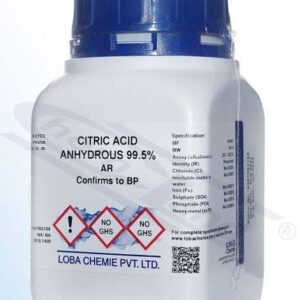
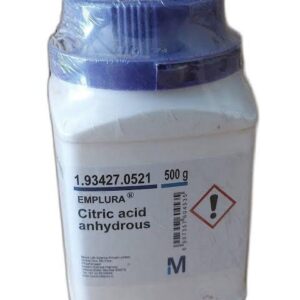
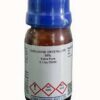
Citric Acid, Anhydrous
Chemical Identity
IUPAC Name: 2-hydroxypropane-1,2,3-tricarboxylic acid
Molecular Formula: C₆H₈O₇
Molecular Weight: 192.12 g/mol
CAS Number: 77-92-9
EC Number: 201-069-1
Grade & Compliance
Grade: Analytical Reagent (AR)
Purity: ≥ 99.5%
Pharmacopoeial Compliance: Conforms to BP (British Pharmacopoeia)
Standards: Suitable for analytical and general laboratory applications
Physical & Chemical Properties
Appearance: White crystalline powder or colorless crystals
Odour: Odourless
Solubility: Freely soluble in water; soluble in ethanol
pH (5% w/v solution): ~2.0 – 2.5
Melting Point: ~153 °C (decomposes)
Density: ~1.665 g/cm³
Specification (Typical AR Limits)
Assay (alkalimetric): ≥ 99.5%
Identity (IR): Passes test
Chloride (Cl⁻): ≤ 0.005%
Sulphate (SO₄²⁻): ≤ 0.01%
Iron (Fe): ≤ 0.001%
Heavy Metals (as Pb): ≤ 0.001%
Insoluble Matter in Water: ≤ 0.01%
Functional Uses (Laboratory Relevance)
Buffer preparation (e.g., citrate buffer systems)
Chelating agent for metal ion binding
pH adjustment in analytical procedures
Standardization of alkaline solutions
Component in biochemical and enzymatic assays
Preparation Insight (Lab Use)
Commonly used with sodium citrate (trisodium citrate dihydrate) to form buffer systems in the pH range 3.0 – 6.2
High solubility ensures rapid dissolution for solution prep
Packaging & Presentation
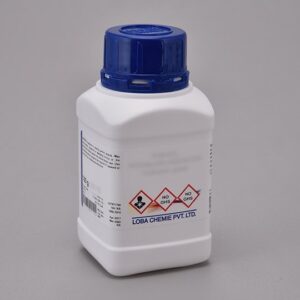
Container Type: Wide-mouth HDPE reagent bottle
Closure: Screw cap with tamper-evident seal
Typical Pack Sizes: 100 g, 500 g, 1 kg
Hazard & Safety Information
GHS Classification: Not classified as hazardous (at typical lab use levels)
Pictogram: May include irritant symbol depending on supplier labeling
Risks: Mild irritation to eyes/skin
Precautions:
Avoid inhalation of dust
Use gloves and safety goggles
Handle in well-ventilated area
Storage Conditions
Store in a cool, dry place
Protect from moisture and humidity (hygroscopic tendency)
Keep container tightly closed
Shelf Life
Typically 3–5 years under proper storage conditions



Reviews
There are no reviews yet.