
Powered By

₦35,000.00 Original price was: ₦35,000.00.₦28,000.00Current price is: ₦28,000.00.
₦27,000.00 Original price was: ₦27,000.00.₦24,000.00Current price is: ₦24,000.00.
₦29,000.00 Original price was: ₦29,000.00.₦24,500.00Current price is: ₦24,500.00.
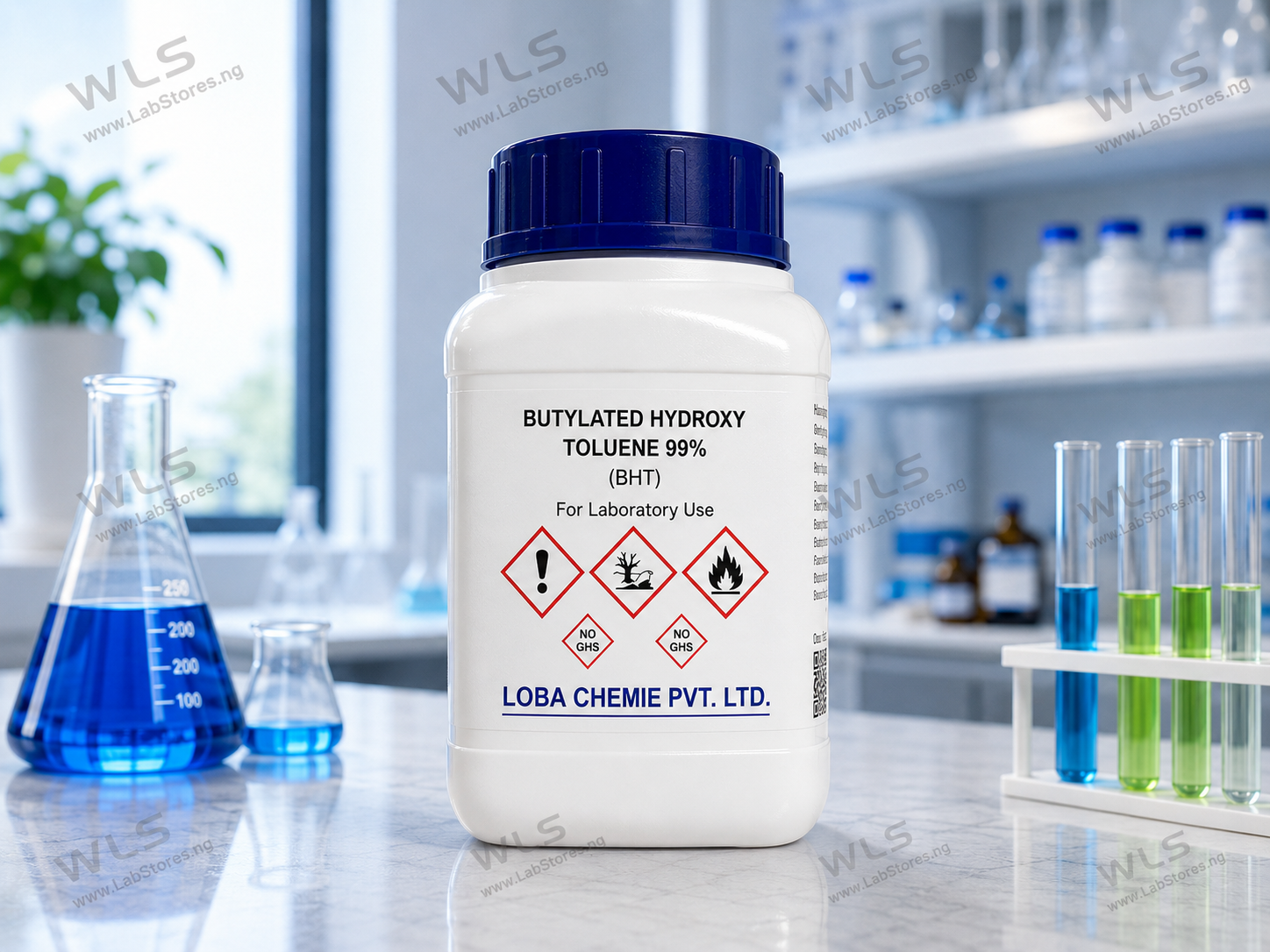
Butylated Hydroxy Toluene 99% (BHT)
Analytical Reagent
100g
Butylated Hydroxy Toluene 99% (BHT)
—
CHEMICAL IDENTITY
Parameter| Specification
Chemical Name| 2,6-Di-tert-butyl-4-methylphenol
Common Name| Butylated Hydroxy Toluene
Abbreviation| BHT
Chemical Formula| C₁₅H₂₄O
Molecular Weight| 220.35 g/mol
CAS Number| 128-37-0
Category| Antioxidant / Laboratory Reagent
Grade| Laboratory Grade / Industrial Grade
Purity| 99%
Manufacturer| Loba Chemie Pvt. Ltd.
—
PRODUCT DESCRIPTION
Butylated Hydroxy Toluene (BHT) is a synthetic phenolic antioxidant extensively used in pharmaceutical, food, cosmetic, polymer, and laboratory applications to inhibit oxidative degradation caused by free radicals and atmospheric oxygen.
The reagent provides exceptional stabilization performance in formulations susceptible to rancidity, oxidative discoloration, and thermal degradation.
—
PHYSICAL & CHEMICAL PROPERTIES
Property| Description
Appearance| White crystalline powder
Odor| Mild characteristic odor
Solubility| Soluble in alcohol, ether, chloroform, oils, and organic solvents
Melting Point| ~69 – 71 °C
Boiling Point| ~265 °C
Stability| Stable under recommended storage conditions
Nature| Phenolic antioxidant
—
APPLICATIONS
Pharmaceutical Applications
– Stabilizer in pharmaceutical formulations
– Prevention of oxidative degradation in active ingredients
– Antioxidant in ointments and creams
Food & Beverage Applications
– Preservation of fats and oils
– Prevention of rancidity
– Shelf-life enhancement
Industrial Applications
– Polymer stabilization
– Rubber manufacturing
– Lubricant stabilization
– Fuel additive systems
Laboratory & Research Applications
– Oxidative stress studies
– Antioxidant research
– Organic synthesis applications
– Analytical chemistry procedures
—
MECHANISM OF ACTION
BHT acts as a free radical scavenger by donating hydrogen atoms to unstable radical species, thereby terminating oxidative chain reactions and protecting sensitive compounds from degradation.
—
SAFETY INFORMATION
Hazard| Details
Health Hazard| Harmful if swallowed
Skin Contact| May cause irritation
Eye Contact| May cause irritation
Environmental Hazard| Toxic to aquatic organisms
Combustibility| Combustible solid
—
SAFETY PRECAUTIONS
– Wear laboratory gloves, goggles, and protective clothing
– Avoid inhalation of dust particles
– Use in well-ventilated environments
– Avoid release into the environment
– Wash thoroughly after handling
—
RECOMMENDED STORAGE
– Store in tightly sealed container
– Keep in cool, dry, well-ventilated area
– Protect from direct sunlight and moisture
– Keep away from strong oxidizing agents
—
ASSOCIATED REAGENTS
– Ethanol
– Methanol
– Acetone
– Hexane
– Chloroform
– Vegetable Oils
—
TARGET USERS
– Pharmaceutical Industries
– Research Laboratories
– Food Processing Industries
– Cosmetic Manufacturers
– Universities & Research Institutes
– Chemical Manufacturing Facilities
—
PACKAGING
Supplied in sealed HDPE laboratory reagent containers with tamper-resistant closure and protective chemical labeling.
—
WLS QUALITY NOTE
This reagent is selected for high-purity antioxidant applications requiring reliable oxidative stabilization performance in pharmaceutical, biochemical, food, and industrial systems.
—
SUPPLIED BY
Website: LabStores.ng
Email: info@labstores.ng
Phone: +2348059999930
Shipping: Nationwide, but Extra shipping fee is applicable for delivery outside Lagos (Please contact us for arrangements)
Ready to ship in 1-3 business days for Nigeria
Shipping Policy
Special products will be charged differently.
Refund Policy
After delivery

https://labstores.ng/shop/

Free Shipping apply to all orders over ₦100,000

Guaranteed Money Back within 30 days return.

2 Day Returns in case you changed your mind.
OTP sent successfully
Reviews
There are no reviews yet.