
Powered By

₦255,000.00 Original price was: ₦255,000.00.₦225,000.00Current price is: ₦225,000.00.

₦580,000.00 Original price was: ₦580,000.00.₦515,000.00Current price is: ₦515,000.00.
₦490,000.00 Original price was: ₦490,000.00.₦430,000.00Current price is: ₦430,000.00.
Adjustable High-Speed Homogenizer
8,000 to 20,000 RPM
Cell / Tissue Homogenizer – Disruptor
Adjustable High-Speed Homogenizer (FSH-2A)
Product Name
Adjustable High-Speed Homogenizer / Tissue Homogenizer, Model FSH-2A. It is a bench-top laboratory homogenizer used for tissue disruption, cell dispersion, emulsification, and liquid-liquid dispersion in small-volume lab work.
Product Type
Laboratory homogenizer / high-speed disperser / tissue mincer. This is equipment, not a chemical substance, so CAS No.: Not applicable.
Key Properties / Description
The FSH-2A uses a high-speed rotor-stator style homogenizing head for rapid mechanical shearing and mixing. Supplier listings describe it as suitable for animal and plant tissue homogenization, crushing, cell dispersion, and for producing fine emulsions or dispersions between otherwise immiscible phases.
Technical Details / Specifications
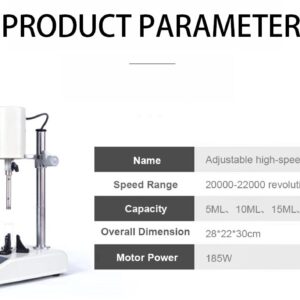
Model references are broadly consistent on the core specs: motor power about 185 W, maximum motor speed around 22,000 rpm, with interchangeable homogenizing tools where one head is commonly listed at 8,000–18,000 rpm and another at 8,000–20,000 rpm. Common working/treatment volume for the small-vessel setup is 5 mL, 10 mL, 15 mL, and 20 mL. One supplier lists dimensions around 270 × 170 × 460 mm and machine weight about 5 kg, while another lists packed dimensions around 300 × 250 × 400 mm and gross/net weight about 8/7 kg; this suggests seller-to-seller variation in how body size versus package size is stated.
Observed Image Details
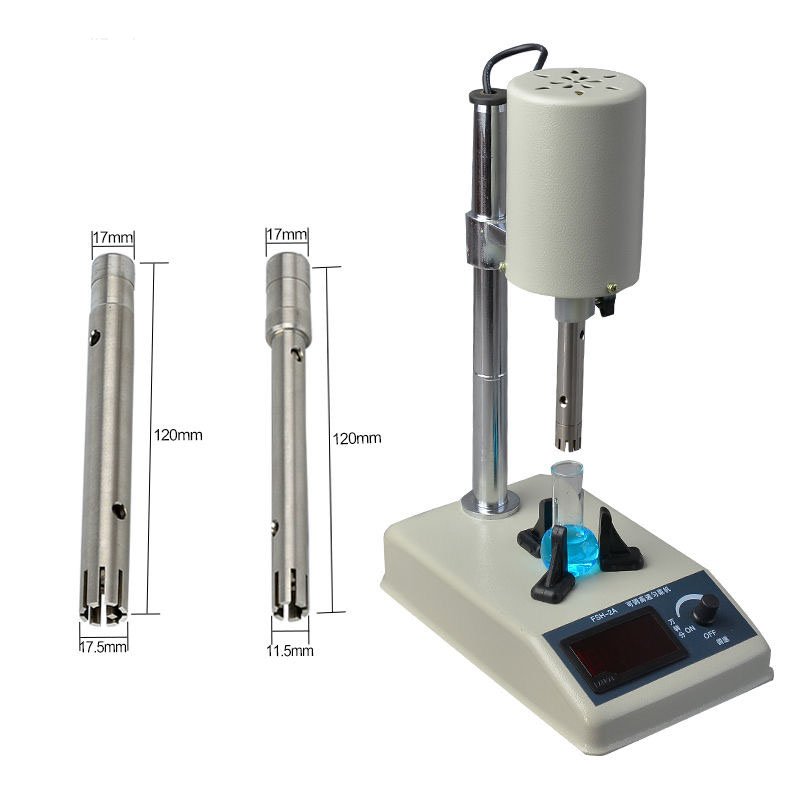
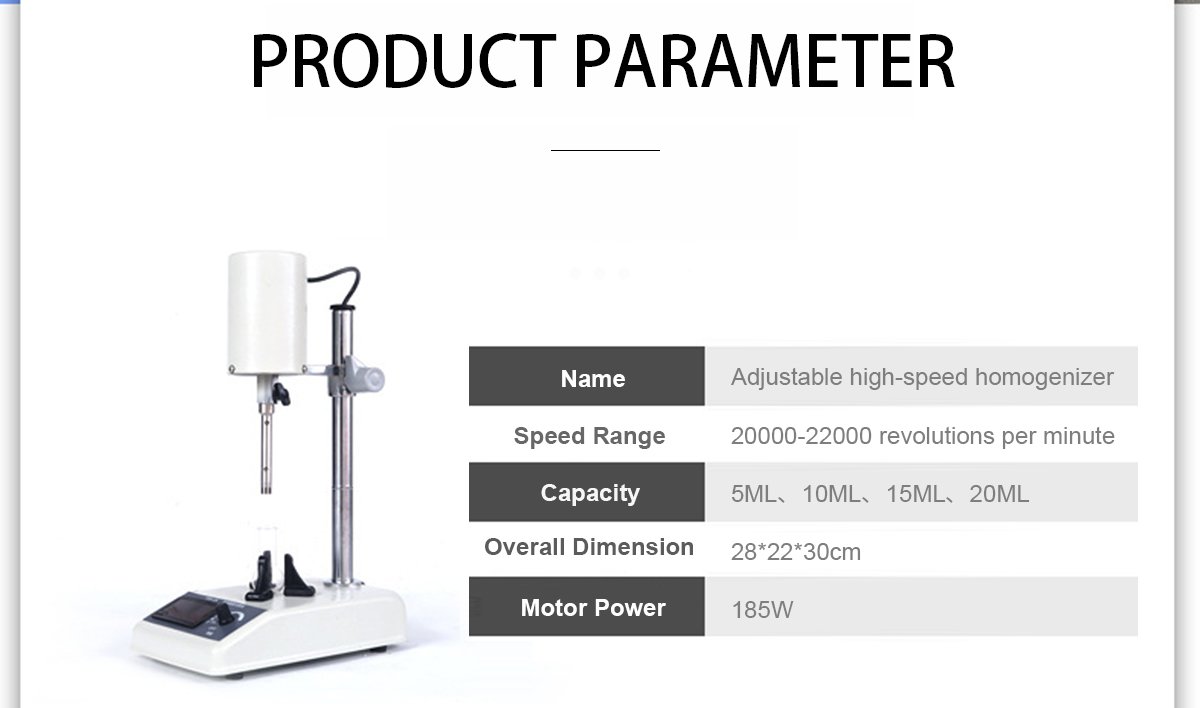
The supplied image shows two stainless homogenizer shafts, each marked 120 mm long with a 17 mm upper diameter; the lower working diameters shown are approximately 17.5 mm and 11.5 mm. The product image also shows a digital-display bench unit with a vertical stand and sample holder. The parameter image states 20,000–22,000 rpm, 5–20 mL capacity, 28 × 22 × 30 cm overall dimension, and 185 W motor power. These image-based figures align broadly with supplier listings, though dimensions differ somewhat across sellers.
Applications
Suitable for:
tissue homogenization in biology and microbiology labs
cell dispersion and sample preparation
emulsification of immiscible liquid phases
extraction work involving trace organics and lipid-soluble components
small-batch laboratory R&D in chemical, food, cosmetic, and academic settings.
Handling / Operating Guidance
Use the appropriate homogenizing shaft for the target sample volume and viscosity. Suppliers commonly recommend short run intervals because this is a high-speed small-batch unit; listings variously state continuous working time of about 3 to 5 minutes max, with pause intervals between runs to reduce motor heating and extend service life.
Storage / Care
Store clean and dry in a dust-free lab environment. After use, promptly clean the stainless homogenizing head to prevent residue buildup and cross-contamination. Keep the motor housing dry and avoid wetting electrical parts. This guidance is inferred from the unit’s bench electrical design and stainless wet-end configuration shown by suppliers.
Hazard / Safety Information
Main hazards are mechanical and electrical, not chemical. Risks include rotating-shaft injury, splashing/aerosol generation, sample cross-contamination, and overheating from overlong continuous runs. Operate with the shaft properly immersed before full-speed ramp-up, secure the vessel firmly, wear eye protection, and disconnect power before changing shafts or cleaning. These are standard safety inferences based on the equipment’s high-speed exposed shaft design and supplier run-time warnings.
Packaging / Standard Supply
Typical supply descriptions include the main homogenizer unit, 2 stainless steel homogenizing knives/shafts, and small-volume vessel/cup options for 5 mL, 10 mL, 15 mL, and 20 mL. Exact package contents can vary by seller.
Comparable Supplier / Market References
Comparable references for this model or equivalent listings were found from Hinotek, Alibaba vendors, InstrumentsTrade/JTYL, Made-in-China suppliers, and various retail resellers. Across these sources, the consistent identity is a compact FSH-2A high-speed lab homogenizer in the 185 W / ~20,000–22,000 rpm class.
Safety Note
For laboratory/research use. Confirm voltage compatibility (110 V or 220 V versions exist) before purchase or deployment. Do not run dry, do not exceed recommended continuous operating time, and verify shaft/sample compatibility before use.
Shipping: Nationwide, but Extra shipping fee is applicable for delivery outside Lagos (Please contact us for arrangements)
Ready to ship in 1-3 business days for Nigeria
Shipping Policy
Special products will be charged differently.
Refund Policy
After delivery

https://labstores.ng/shop/

Free Shipping apply to all orders over ₦100,000

Guaranteed Money Back within 30 days return.

2 Day Returns in case you changed your mind.
OTP sent successfully
Reviews
There are no reviews yet.